
Rutherford Projected Versus Actual Release
NCDAC Offender Public Information uses the exact field name Projected Release Date. It is a calculation based on the state record at that point in time. The same detail record may later show an Actual Release Date. Read that completed date with Inmate Status and Last Movement or Last Movement Date before concluding that release occurred.
A projected date belongs to a sentenced case. A pretrial detainee at Rutherford County Detention Center has no fixed sentence-release date merely because a charge or bond exists. Court action, bond satisfaction, dismissal, transfer, or another legal event may end that jail hold. The jail’s actual movement record, not an estimated prison field, proves what the sheriff did.
| Field or event | What it answers | What it cannot prove alone |
|---|---|---|
| Projected Release Date | Current NCDAC calculation | That release occurred |
| Actual Release Date | Recorded state release date | That all supervision ended |
| Last Movement | Most recent prison movement and date | Community release unless the movement says so |
| Court judgment | Sentence and court order | Exact time the jail carried out release |
| County release record | Sheriff release or transfer event | NCDAC prison discharge in another record system |
Find Rutherford State Release Dates
Use NCDAC OPI for a person imprisoned by the state or supervised by NCDAC. The Criminal Offender Searches gateway explains that OPI includes state-prison offenders, probationers, parolees, and history from 1972, while excluding county-jail-only records. This scope rule prevents a common mistake: a failed OPI search does not disprove a short Rutherford County jail stay or bond release.
- Open the OPI general search. Choose Active Inmate for a current prisoner, or All when release may have occurred.
- Search by the seven-digit offender number when available. Otherwise enter the name and narrow with middle name, Soundex, date of birth or age range, sex, race, or ethnicity.
- Match identifiers and open the correct detail. Note the prison status, sentence data, minimum and maximum terms, county and docket, detainer indicators, and Projected Release Date.
- Save the exact label and date. Do not round it, apply a percentage, or call it guaranteed.
- Return after that date. Look for Actual Release Date, inactive inmate status, Last Movement and date, plus any active probation, parole, or post-release status.
- If the fields conflict, contact NCDAC or submit an online state records request using the offender number.
The official Rutherford state-prison search form is shown below.
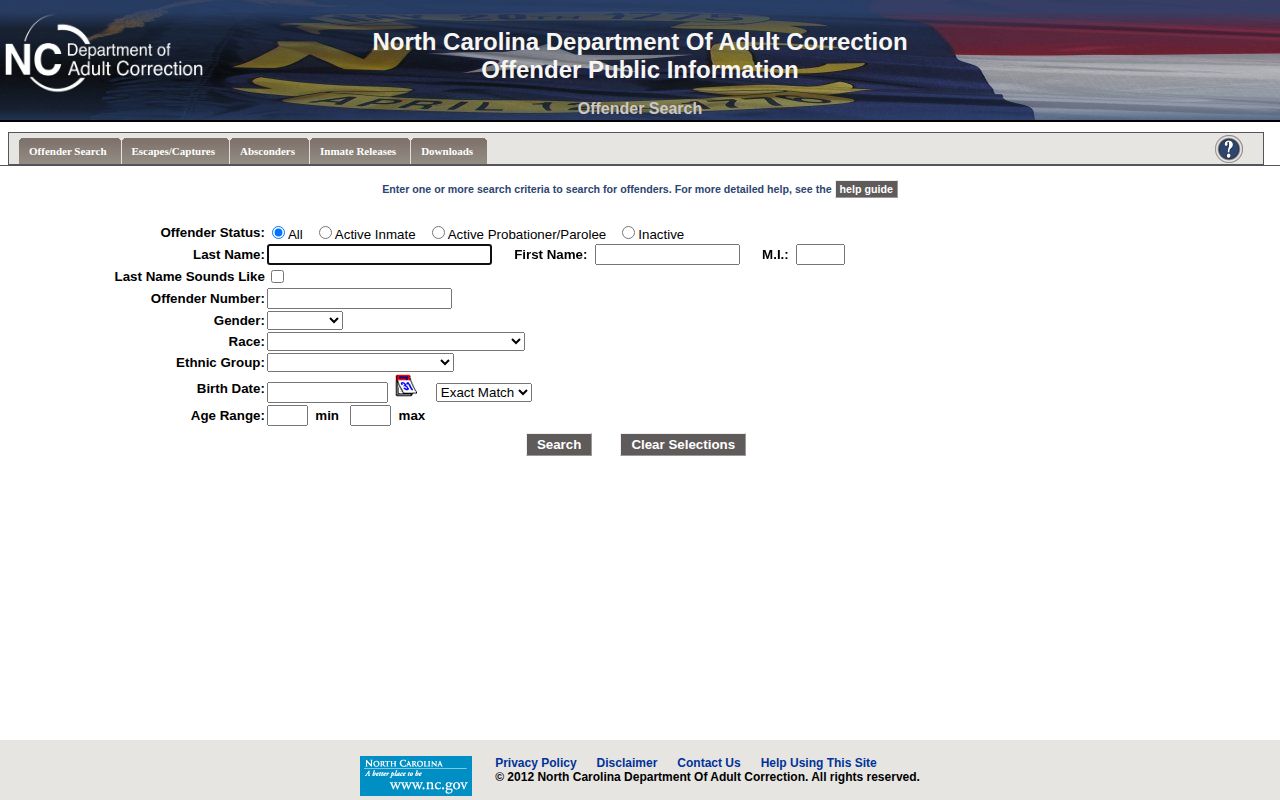
The form’s custody and supervision choices matter because prison release may be followed by active post-release supervision.
Rutherford Jail Release Date Records
For a sentence served at Rutherford County Detention Center, OPI may never apply. Start with the case judgment in the North Carolina eCourts Portal or the clerk’s record. The judgment can show the term, whether sentences are concurrent or consecutive, and credit ordered for prior confinement. It still does not establish the exact time Detention Processing completed a release.
Call Rutherford County Detention Processing at 828-287-6250 for the immediate custody question. For a durable record, use the county NextRequest portal. Ask for the release computation or the actual release or movement record tied to the booking. Include the full name, date of birth if known, booking date range, facility, case number, and booking number. Request release date and time, release type, and receiving agency if the event was a transfer and that field is public.
The Rutherford County records-request channel appears here.
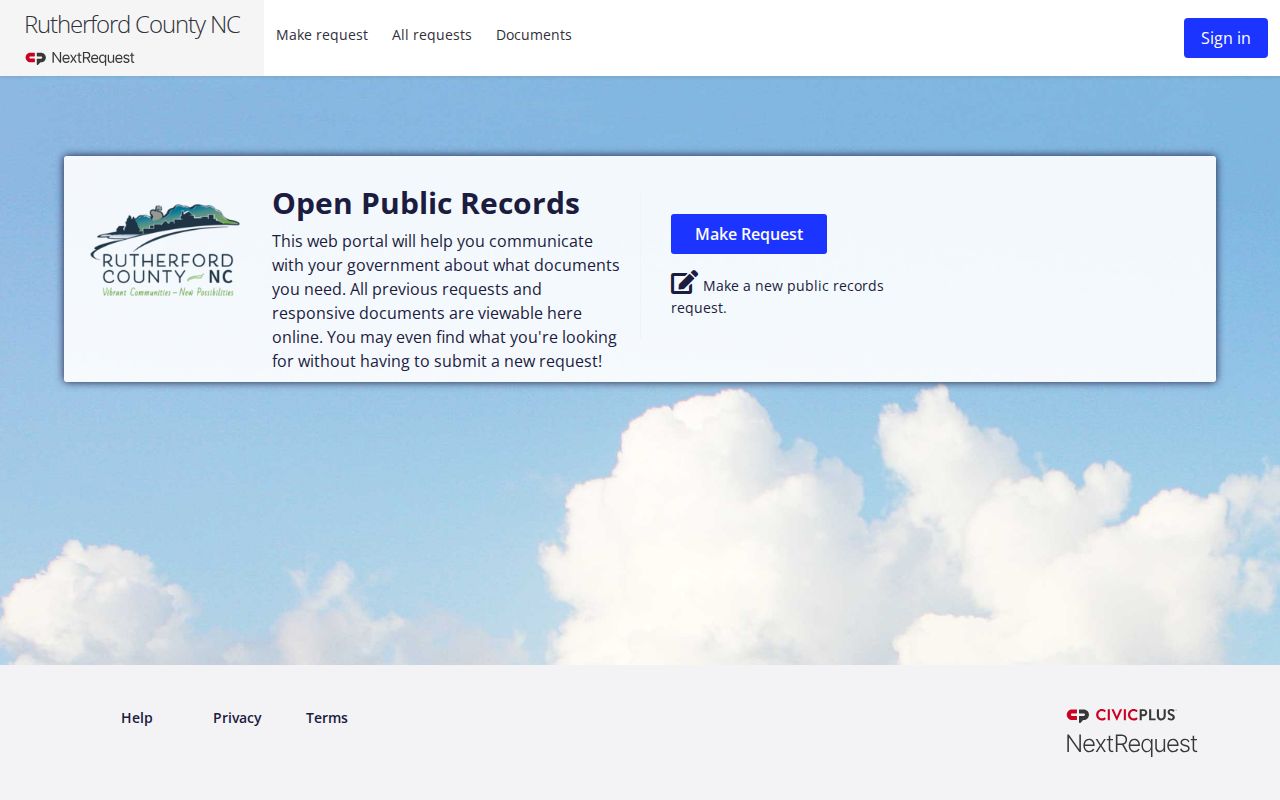
A tracked response can distinguish community release from transfer, a difference a missing current-custody name cannot resolve.
No fixed local fee, turnaround, or records-counter hours were verified. Ask for a cost estimate if a request expands, and call before an in-person visit. The detention address is 198 North Washington Street, Rutherfordton, NC 28139; the sheriff administrative office is at another location.
Rutherford Earned-Time Release Rules
North Carolina does not have a blanket rule that every prisoner serves 85 percent. Under G.S. 15A-1340.13(d), a Structured Sentencing felony prisoner generally must serve the judicial minimum, subject to the statute’s exception. Earned time may reduce the maximum term only to that minimum, not below it. The paired minimum and maximum structure comes from the felony framework in G.S. 15A-1340.17.
G.S. 148-13 requires NCDAC rules for earning and forfeiting sentence credits. It also distributes state regulations to local jail administrators for sentenced jail prisoners. Credits are conditional. They can be earned, lost, or restored under governing rules, so a projected date may change without a new sentence length appearing to an outside reader.
The official earned-time statute shows why credits cannot be treated as an automatic discount.
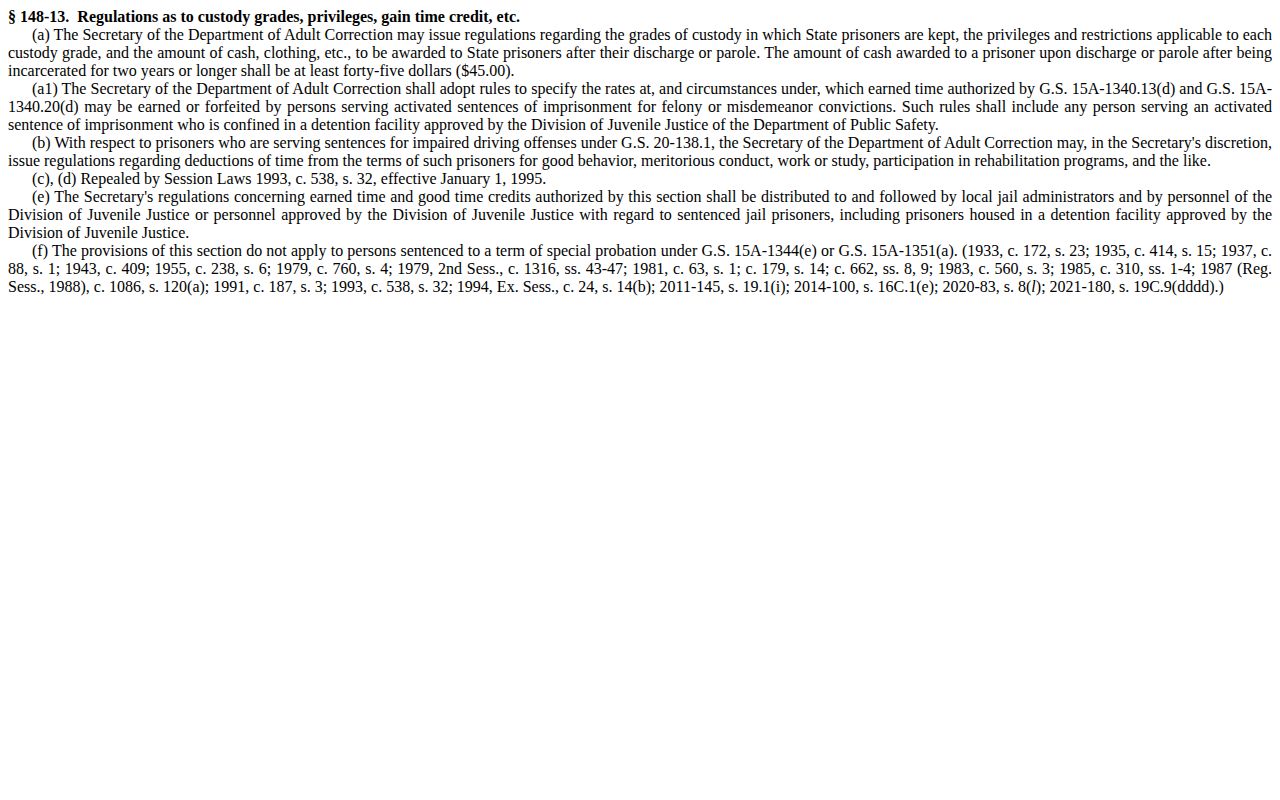
The statute governs agency rules and credit administration; it does not let a web searcher compute a definitive date without the sentence record.
Activated misdemeanor terms follow a different provision. G.S. 15A-1340.20 generally requires service of each day subject to authorized credits, with no more than four days of earned time per month under the combined rule and statute. A Rutherford County jail calculation also depends on confinement credit, the judgment, sentence structure, and jail administration.
No Rutherford 85-Percent Formula
The distinctive North Carolina rule is a floor, not a simple percentage. The judicial minimum controls how far earned time may reduce a Structured Sentencing felony maximum. For that reason, two sentences with dates that look similar may produce different calculations. Credits can also be forfeited, and a correction to sentence data can alter the projection.
This is why OPI’s wording matters. Projected Release Date is the right label before release. After the date, check Actual Release Date, last movement, incarceration status, and the separate supervision field. Physical release to post-release supervision is not full discharge. Work release at Rutherford Correctional Center remains imprisonment, even though a participant may leave the grounds for an approved assignment. A prison transfer also continues custody and must not be restated as release home. Each later custodian needs its own status check.
Note: Never subtract an assumed percentage from a Rutherford County sentence and present the result as an official release date.
Why Rutherford Release Dates Change
A projection can move because the legal and correction record changes. Some factors affect the calculation. Others affect whether the person can leave one custodian even when a term ends. Read the field beside its source rather than guessing which event occurred.
| Factor | Possible effect | Where to verify |
|---|---|---|
| Earned-time award | May reduce the maximum toward the lawful minimum | NCDAC sentence record and credit rules |
| Credit forfeiture or restoration | May move the projected date later or earlier | NCDAC record and agency correction channel |
| Corrected judgment or sentence data | Changes the calculation’s inputs | Court judgment and NCDAC detail |
| Concurrent or consecutive terms | Changes how multiple terms are served | Judgment and sentence history |
| Detainer or other hold | May cause transfer or continued custody elsewhere | OPI flag, sheriff record, and receiving agency |
| Parole Commission action | Affects eligible older or special parole cases | Commission review records and OPI |
| Post-release supervision | Ends prison custody but continues state supervision | Separate OPI supervision status |
A detainer is a hold or request from another authority. It can lead to transfer rather than freedom. Likewise, an appellate or trial-court order can alter the governing sentence. If the field changes, preserve both dates and ask the agency to explain the current record instead of selecting the earlier result.
Sentence structure can move the calculation without any simple percentage. Concurrent terms run together as the judgment directs, while consecutive terms run in sequence. Credit for prior confinement can affect time still owed. Disciplinary credit may be lost or restored under agency rules. A corrected judgment, appellate order, or amended sentence record can also change the calculation. Parole Commission action matters only in an eligible case, and movement to post-release supervision ends prison confinement without ending the whole correctional relationship.
A county sentence needs its own records. The judgment supplies the imposed term and any stated confinement credit, but Detention Processing administers the local release computation. G.S. 148-13(e) gives state credit regulations a role for sentenced jail prisoners; it does not let a reader determine an exact Rutherford County release day from the statute alone. Ask for the existing computation or actual release entry rather than submitting a homemade date.
Confirm Rutherford Actual Release
After the projected date passes, repeat the search. For NCDAC, require a consistent set: Actual Release Date, inactive incarceration status, and a last movement that fits the event. Then check whether probation, parole, or post-release supervision remains active through the Post-Release Supervision lookup. For the county jail, obtain the dated sheriff release or movement record and compare it with the court docket.
NC SAVAN and VINELink can send release or transfer notifications for covered people. Register through the VINE Inmate Check path, but read the event literally. A transfer alert is not community release, and a timely alert is not a certified record. The originating jail or NCDAC entry supplies documentary confirmation.
The NCDAC monthly Inmate Release Search can also be filtered by Rutherford, year, month, and name. Its results show offender number, Release Date, primary offense or qualifier, and Type of Release. It covers state-prison releases, not a sheriff jail feed. The Rutherford County released inmate search explains how to combine state, county, VINE, and court sources when custody history crosses systems.
Public Record Search
Sponsored Results